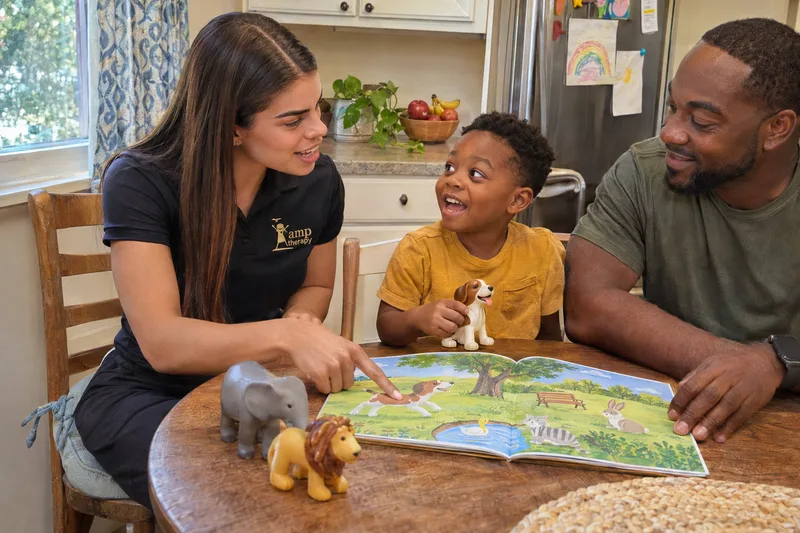
“Shouldn’t they be talking by now?”
Your toddler points, grunts and drags you to the fridge, but the words aren’t coming. A cousin the same age is already saying “I want juice.” Friends tell you boys talk late, or that kids learning two languages take longer. Your pediatrician says to give it a few months.
It’s one of the most common worries our speech therapists hear, and you’re right to pay attention. Here’s what typical speech looks like by age, the signs worth checking, and how to get your child evaluated in Central Florida or Brevard.
Speech and language are two different things
When parents say “speech,” they usually mean everything. Therapists split it into two parts, because a child can be behind in one and right on track in the other.
- Language is understanding and using words: following directions, knowing names for things, putting words together to say what they want.
- Speech is making the sounds: how clearly your child says the words they know.
A toddler who understands everything you say but uses only a few words has a different picture from a child who talks a lot but is hard to understand. Both are worth a look, and both respond well to help.
What most children can do, by age
This chart follows the CDC’s developmental milestones. Each age shows what most children (about three in four) can do by then, so a child still working on a skill isn’t automatically behind. What matters most is steady progress.
| Age | Most children can… |
|---|---|
| 6 months | Take turns making sounds with you; blow “raspberries”; squeal |
| 9 months | Babble strings like “mamama” and “bababa”; look when you call their name |
| 12 months | Wave bye-bye; call a parent “mama,” “dada” or another special name; understand “no” |
| 15 months | Try to say one or two words besides “mama” or “dada”; point to ask for something |
| 18 months | Try to say three or more words besides “mama” or “dada”; follow a one-step direction without a gesture, like “Give it to me” |
| 2 years | Put two words together, like “more milk”; point to at least two body parts when asked |
| 30 months | Say about 50 words; use two or more words with an action word, like “doggie run” |
| 3 years | Hold a back-and-forth conversation; ask who, what, where or why questions; talk well enough that others understand most of the time |
Late talker or speech delay? Somewhere between one in ten and one in five two-year-olds are “late talkers.” Many catch up on their own, but some don’t, and there’s no reliable way to tell which group a child is in just by waiting. That’s why therapists suggest an evaluation instead of a wait-and-see.
Signs it’s time to get your child checked
None of these means something is definitely wrong. Each one means it’s worth a conversation with your pediatrician or a speech-language pathologist.
- No babbling, pointing or waving by 12 months. Gestures come before words and are an early part of language.
- No single words by 16 months.
- No two-word phrases by 24 months that your child makes up on their own, like “daddy go” (not just repeating you).
- Trouble understanding. Doesn’t follow simple directions or doesn’t look when you name a familiar object.
- Hard to understand at age 3. If family members still can’t understand your child most of the time, a speech evaluation can help.
- Losing words or skills your child used to have, at any age. Call your pediatrician about this one right away.
What you can do at home starting today
These help every child, whether or not they turn out to need therapy:
- Narrate your day. “I’m cutting the apple. Crunch! Your turn.” Short, simple sentences give your child words to copy.
- Add one word. If your child says “ball,” you say “red ball” or “ball rolls.”
- Wait. After you ask a question, count to five in your head. Toddlers need time to answer.
- Read together, and let them point. Name the pictures, then pause so your child can point or fill in the word.
- Turn screens off in the background. Back-and-forth talk with a person teaches language far better than a show does.
- Speak the language you know best. If your family speaks Spanish at home, keep speaking Spanish. Rich language in any language helps.
Getting an evaluation in Central Florida and Brevard
- Under age 3: Florida’s Early Steps program evaluates babies and toddlers at no cost to the family, and parents can refer their own child. If your child qualifies, services happen where your child already spends the day, at home or at daycare. AMP is an Early Steps provider, and our early intervention specialists work with families across the area.
- Age 3 and up: your public school district’s Child Find program can evaluate preschoolers, and your pediatrician can refer your child for outpatient speech therapy covered by insurance.
- Through AMP directly: we serve families across Central Florida and Brevard (see our service areas), at home, at daycare or school, or by telehealth when it’s a good fit. We accept Florida Medicaid and most major insurance plans, and we check your benefits before you commit to anything.
Quick answers to what parents ask us most
My child is learning two languages. Is that why they’re behind?
No. Learning two languages does not cause a speech or language delay. Bilingual toddlers sometimes mix words from both languages, which is normal. When we evaluate a bilingual child, we look at both languages together, and AMP’s team speaks Spanish.
Should I wait and see if they catch up?
Many late talkers do catch up, but nobody can tell in advance which ones will. An evaluation doesn’t commit you to therapy. It gives you facts instead of guesses, and if help is needed, starting early makes it easier.
Do I need a doctor’s referral?
Not for Florida Early Steps: parents can refer their own child under age 3. For therapy through insurance, some plans ask for a prescription from your pediatrician. Our intake team can check your plan for you.
Could it be a hearing problem?
It can be. Even mild or on-and-off hearing loss, such as fluid from repeated ear infections, can slow speech. A hearing test is often one of the first steps, and your pediatrician can order one.
How AMP can help
AMP Pediatric Therapy’s licensed speech-language pathologists work with children from birth to 21 across Central Florida and Brevard. Wondering about your child’s talking? Tell us about your child and we’ll reach out within one business day.
Know a parent who’s been asking “Shouldn’t my child be talking by now?” Send this their way.
Sources: CDC “Learn the Signs. Act Early.” developmental milestones (2022); American Speech-Language-Hearing Association guidance on late language emergence and bilingual development; Florida Department of Health Early Steps program.